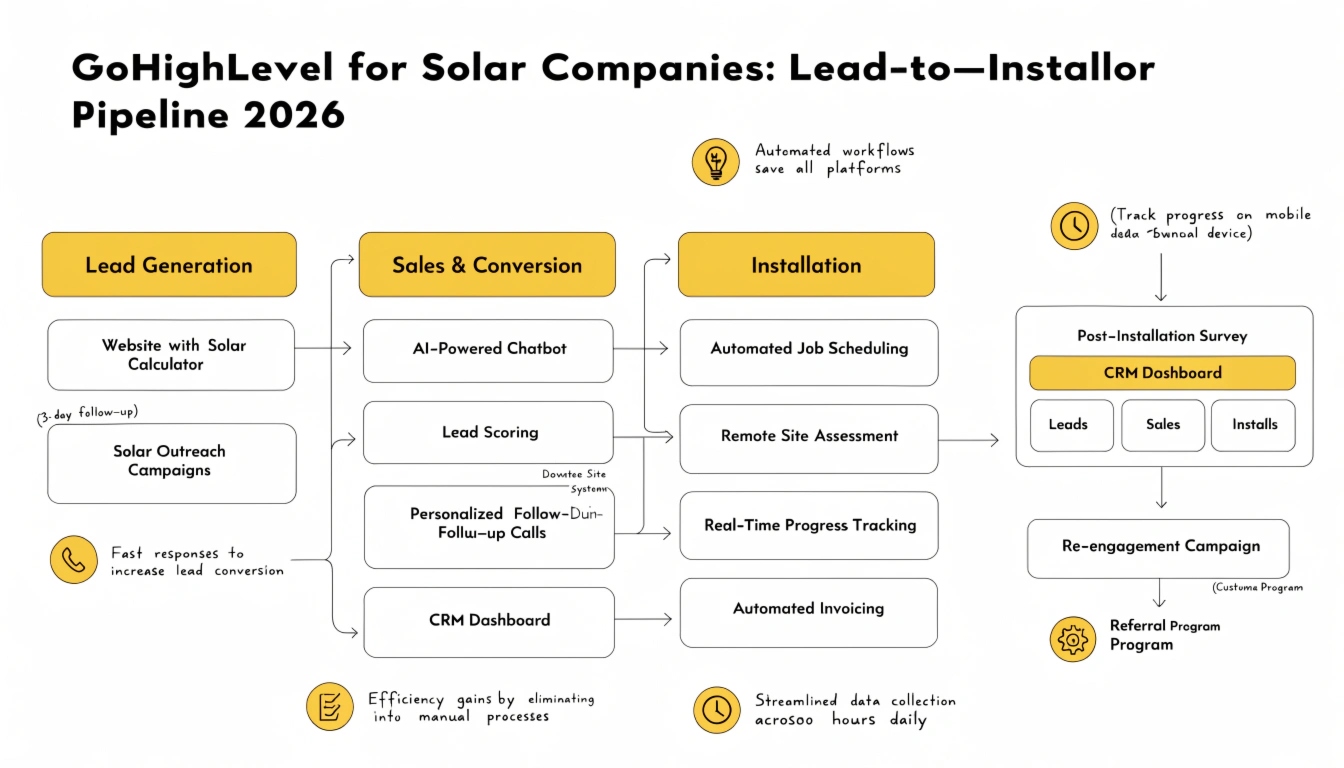
GoHighLevel for Solar Companies: Lead-to-Installer Pipeline 2026
GoHighLevel for solar companies handles the complete lead-to-installer pipeline — qualification, long-cycle nurture (often 60-180 days from lead to install), site survey scheduling, permit and install tracking, and post-installation referral automation.
With a single solar install averaging $20K-$60K, the math on automation is unambiguous: capturing one additional lead per month from a previously-ignored cold list pays for the entire GHL setup.
This guide covers the complete solar configuration including qualification scripts, integration with Aurora Solar, and finance application workflows.
Why solar companies need long-cycle automation
Solar sales aren’t impulse purchases. The average residential solar lead takes 60-180 days from first inquiry to signed contract.
During that window, the homeowner is comparing 3-5 installers, getting quotes, modeling financing options, and overcoming family resistance. The installer who stays in front of them with helpful content wins the contract.
Manual follow-up doesn’t scale. A solo solar consultant manages maybe 30 active leads at once. With GoHighLevel automation, the same consultant manages 200+ leads in nurture, with the system handling 90% of the touchpoints automatically and flagging only the leads showing buying signals.
Lead qualification automation
Solar lead qualification depends on three factors: home ownership, roof condition, and electricity bill size. GoHighLevel captures all three in the initial form, then routes leads automatically.
A qualified lead (homeowner with $150+/month electric bill and a south-facing roof under 15 years old) gets fast-tracked to a consultant call. An unqualified lead (renter, low bill, or roof needing replacement first) gets routed to a long-form nurture sequence that addresses their specific blocker before re-qualifying in 60-90 days.
Read this: GoHighLevel for Law Firms 2026: Compliant Intake at Scale
Long-cycle nurture sequences
The 90-day solar nurture sequence is the highest-ROI workflow in any solar GHL setup. Below is the typical structure used by our solar clients.
Foundation content
How solar actually works (myth-busting). Federal tax credits explained. State incentives by zip code. Average savings calculations using their specific bill size.
Comparison content
Solar vs. continuing to pay the utility (NPV math). Owning vs. leasing. Battery storage decisions. Equipment quality differences (Tier 1 vs. lower-tier panels).
Social proof
Local installation case studies (with permission). Real customer interviews. Before/after monthly bill comparisons. Neighborhood installation maps showing how many homes already have solar.
Direct ask
Limited-time financing offers (real, not fake urgency). Group-buy discounts. End-of-year tax credit pressure (legitimate fiscal urgency). One direct “book your site survey” CTA per email.
Site survey scheduling
Once a lead is hot enough to book a site survey, GoHighLevel handles the calendar logistics. Workflow checks technician availability by zip code, books a 30-60 minute on-site visit, sends confirmation 24 hours prior with the technician’s name, sends arrival SMS when the tech is en route, and triggers the next sequence based on survey outcome.
Permit and install pipeline
Solar projects have specific stages that often confuse customers: site survey → design → contract → permit application → permit approval → installation → inspection → utility interconnection → activation. GoHighLevel pipelines track every stage with automated customer communications at each transition.
This single set of automated communications reduces customer support inquiries by 60-80% in our solar client implementations.
Read this: GoHighLevel for Real Estate 2026: The Ultimate Lead Conversion Engine
Finance application workflows
Most residential solar is financed. The application workflow integrates with finance providers like Sunlight Financial, Mosaic, or GoodLeap via webhook. GoHighLevel captures the application data in a form, sends it to the finance provider’s API, and routes the approval/decline response back into the customer’s workflow stage.
Integration with Aurora Solar and design software
Solar design tools like Aurora Solar generate the actual system design and savings calculations. GoHighLevel doesn’t replace these — it integrates with them.
The typical setup uses Aurora for design and modeling, with the proposal data passed to GoHighLevel for customer communications and contract management.
Customer referral automation
Solar referrals are the highest-margin lead source. A homeowner who just installed solar typically has 5-10 neighbors and friends who’ve asked about it.
The referral workflow triggers 30 days post-activation: “Your system is producing well. Know any neighbors curious about solar? We pay $500 for any referral that becomes an install.” Most solar companies running this workflow generate 1-3 referral leads per installed customer.
Read this: GoHighLevel for Chiropractors 2026: How to Fill Your Schedule and Increase Patient Lifetime Value
ROI on a single $30K install
Solar’s high average order value makes the GHL math trivial. A $97/month GoHighLevel subscription costs $1,164 per year.
A single solar installation typically generates $5,000-$8,000 in installer profit. If the GHL system captures even one additional install per year that would have otherwise been lost, the ROI is 4-7x. Most solar clients we work with see 3-5 additional installs per quarter from previously-cold leads.
Frequently Asked Questions
How do solar companies use GoHighLevel?
Solar companies use GoHighLevel for lead qualification (homeowner status, bill size, roof condition), 90-day nurture sequences for long-cycle leads, site survey scheduling, permit and installation pipeline tracking, finance application workflows, and post-install referral automation. The platform handles every customer touchpoint from inquiry to activation.
What workflows close solar deals fastest?
The three highest-impact solar workflows are: instant SMS response to new leads (under 60 seconds), the 90-day educational nurture for unqualified leads, and post-install referral automation triggered 30 days after system activation. These three workflows generate the highest ROI for solar installers.
Does GoHighLevel integrate with Aurora Solar?
Yes, via Zapier or custom API integration. The typical integration pulls proposal data from Aurora into GoHighLevel for customer communications and contract management.
Aurora handles the design and modeling; GHL handles the customer journey from lead to activation.
Can GoHighLevel handle solar finance applications?
Yes. GoHighLevel’s webhook system integrates with major solar finance providers including Sunlight Financial, Mosaic, and GoodLeap.
The workflow captures application data, sends it to the finance provider, and routes the approval response back into the customer’s pipeline stage.
How long does a solar GoHighLevel setup take?
A complete solar GHL setup takes 14-21 business days. The base setup (workflows, pipelines, calendar, basic integrations) takes 14 days.
Adding custom finance integration with Sunlight or GoodLeap adds another 5-7 days. Multi-state operations with multiple sub-accounts take 21 days total.
Ready to capture more solar leads?
Book a free solar GHL audit. We’ll review your current lead handling, identify how many leads you’re losing in the long-cycle nurture period, and quote a complete GHL setup tuned to your sales process. Most solar clients add 3-5 incremental installs per quarter — paying for the system many times over.